Showing posts with label guide. Show all posts
Monday, 13 June 2016
Moodle 3.0 upgrade
It is time for our Summer Moodle upgrade again!
On June 27th we will be upgrading to Moodle 3.0.3 (from 2.8). While the number is a big jump the differences in the platform are not too large and so should have a minimal impact on students and staff. Most of the improvements, bug fixes and security updates are internal and will not be directly noticeable.
As with the previous upgrades there will be up to one day of read-only access while the upgrade proceeds (i.e. no Turnitin submissions, course editing, forum posting etc).
Read only access will be from 09:30 until completion, sometime before 17:30. There may be a brief (less than 15 minutes of outage while the final switch over is performed).
Moodle 3.x upgrade
On June 27th 2016 we will upgrade our live Moodle instance to version 3.0.3
This will bring stability, security and performance enhancements along with upgraded integrations and plugins.
Note: we will also have Mahara upgraded to 15.10 at the same time.
Upgrade plan
It will take between 4 and 7 hours to upgrade the platform. We will plan for the Moodle site to be in read only mode from 09.30 until 17.30.
Process carried out by ULCC
0. Internal upgrade test run two weeks before actual upgrade. Any external access (firewall, SFTP) configurations are updated.
1. On the day of the update the site is placed into read only mode at 09:30
2. A clone of the site is taken and copied to new infrastructure
3. Update is applied to the new site
4. Site is checked by ULCC Support team
5. DNS switch is performed by ULCC so that the current site is switched to the new upgraded site. I.e. moodle.brookes.ac.uk goes to new site
6. Admins are added back in and site is taken out of read only mode
Note: there may be a brief (<15 minutes) outage while DNS is switched over.
Backup out Plan
1. If an error is encountered during the update they will restore service from the backup (this is allowed for in the planned downtime)
2. Post analysis will be run and new update date will be arranged
What is new in Moodle 3?
Navigation Changes
Since 2.9 Moodle has improved the UI for user profiles and homepages
My home is now Dashboard
More information can be found here https://docs.moodle.org/29/en/Dashboard
New Grades page
Students can access an overview of their grades in all courses via a Grades link in the user menu (top right of each page). This lists courses they are students in under the heading ‘Courses I am taking’. If a student clicks on a course name, they will be taken to their user report for activities in that course.
Themes
Adaptable and Klass themes added
Atto Editor
Now includes math notation
Keyboard shortcut (ctrl+K) for hyperlinks
There have been improvements in adding and configuring tables when editing text, plus there are new equations in the equation editor
Under the hood
Improvements to web services, mobile services and administration of file resources.
Ref:
Monday, 30 November 2015
BRISC Quick Start Guide
Continuing the overviews of our apps, here is BRISC (the “BRookes Individual Skills Catcher” app).
This has been developed in conjunction with the Faculty of Business but it could be invaluable to any Brookes student.
The app is designed to allow students to simply and quickly capture personal reminders of employability skills they have gained, inside or outside of their course, enabling easy recall for later use in job or placement interviews. These skills, a valuable resource, could otherwise be overlooked or forgotten.
How it works
Students access the app either directly from within Moodle (Brookes Apps -> BRISC) or by logging-in to a mobile version using their usual Brookes credentials. The relevant skill heading can then be selected either from the 'Brookes Attribute' or 'CBI/NUS' categories or from a full alphabetical list.
Previous entries can be viewed or new entries can be added. New entries will have a title, a text body (what to remember) and, if required, a URL link to a further explanation or video. If relevant, a new entry can also be associated with one of the student's current modules.
Note: the app uses standard Moodle Blogs that can also be accessed from any PC, mobile device or Chromebook. Be aware that any entries made directly via Moodle itself would need to be flagged as 'draft' (private) to ensure confidentiality.
Note: the app uses standard Moodle Blogs that can also be accessed from any PC, mobile device or Chromebook. Be aware that any entries made directly via Moodle itself would need to be flagged as 'draft' (private) to ensure confidentiality.
The mobile app can be downloaded for free from Google Play, the Apple App Store or the Windows Store.
Logging-in
 Login is done with Brookes staff or student credentials, as for Moodle (staff or student number).
Logging-in

Categories
 Once logged in a user will see the possible selection methods. They may then choose a skill category or a list of all skills.
Skills

Entries

At this point the user can either select a previous entry to view or opt to add a new entry.
New Entry

New entries will have a title, a text body (what to remember) and, if required, a URL link to a further explanation or video. If relevant, a new entry can also be associated with one of the student's current modules.
Please note: mobile users will remain logged into the app unless they use the Logout button.
Video - BRISC Trailer
Produced by the Faculty of Business
Video - BRISC Tutorial
Produced by the Faculty of Business
Friday, 23 October 2015
QuAK Quick Start Guide

As we will be demonstrating a few of our apps at the next Communications Forum at Brookes next Monday it may be useful to have an overview of the intended usage of the apps. To kick things off here is QuAK (the “Question Answer Knowledge” app)
This has been developed from a winning entry in the Oxford Brookes app competition, submitted by Brookes student Tom Wilford.
The app is designed to allow students to ask questions during lectures either anonymously or not, and for module leaders and other students to be able to answer them, either in lectures or at a later time.
How it works
Students log into the app using their usual Brookes credentials and see a list of courses from the semester which they are currently enrolled on. They can then click on a course to see question forums within that course. Once in a question forum (e.g. Week 8) students can ask a question or suggest an answer to an existing question. Please note that answers are not anonymous.
Lecturers will log in and be able to set-up question forums on any of their courses. These could, for example, relate to a particular week in the semester.
Note: the app uses Forums that are stored within Moodle so can be accessed from any PC, mobile device or Chromebook. This also allows content to be searched, exported, etc. Note that any posts made directly via Moodle will not be anonymous.
The app can be downloaded for free from Google Play or the Apple App Store

Login is done with Brookes staff or student credentials, as for Moodle (staff or student number).

Courses Page
Once logged in all users will see a list of their courses which are running in the current semester.
They may then choose a course.

If a digit is entered under “week number/topic” a forum activity will be added under that week number on the relevant course. e.g. if “5” is entered as the “week number/topic” then this activity will be listed under week 5 on the course.
Alternatively text may be entered and the question forum will be added to the first section of the course.
Back on the Question Forums page users can select a forum and will then see a list of questions that have been asked.

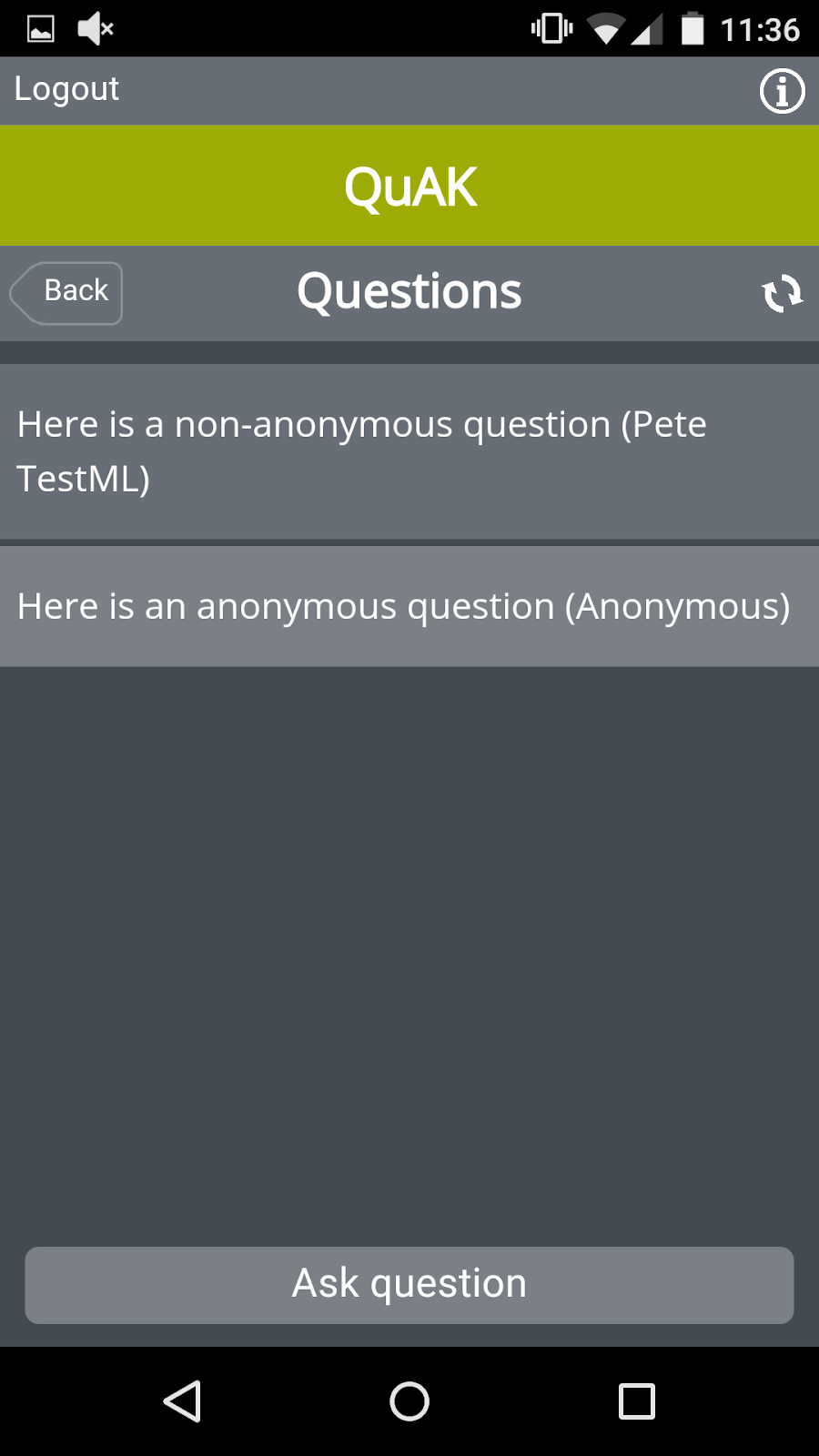
At the bottom of the page users have an option to “Ask question” and can choose to be anonymous or not. The default setting is anonymous.

On the Answers page, module leaders can use the “Delete question” button to delete a question, if required.
On the Answers page the identity of the person answering will always be shown.
The refresh button can be used to update the list of questions and answers at any time. Going into a page will also force it to refresh.
Please note: users will remain logged into the app unless they use the Logout button.
That is it. Hopefully it is simple and straightforward and easy to use in many situations. We recently used it at an OBIS Development Day and it proved useful for capturing interesting questions that there may not have been time to deal with individually. These questions were then followed up with answers after the session. As everything is stored in Moodle activities these can be revisited at any time to promote further discussion or reflection.
Subscribe to:
Posts
(
Atom
)